Natural Refrigerants in Lumikko’s Product Development
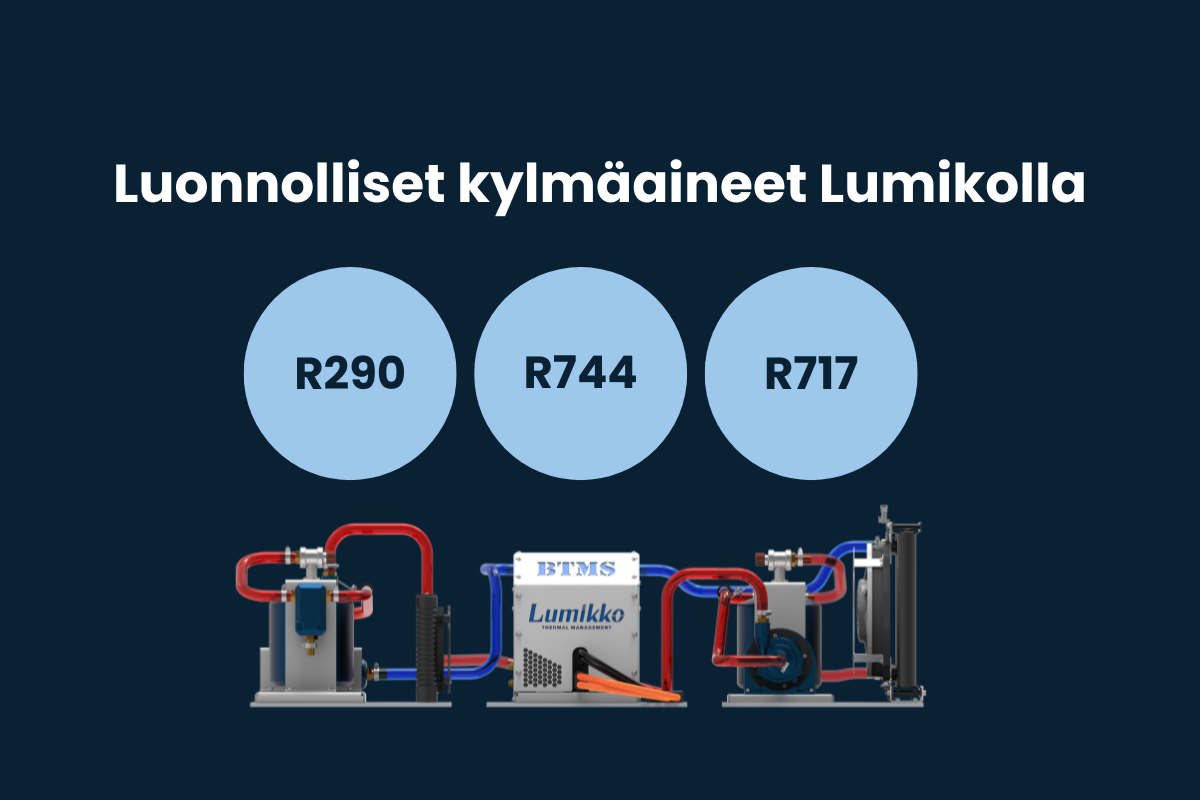
As we approach the end of the year, one of Lumikko’s highlights has been the launch of the new Lumikko BTMS system. Lumikko BTMS is our first solution that utilizes a natural refrigerant, propane (R290). In the coming year, we will develop natural-refrigerant versions of several of our devices.
The transition toward more environmentally friendly refrigerants is both a major technological leap and a response to our customers’ environmental goals as well as the future requirements of the entire industry.
What are natural refrigerants and why do they matter?
Natural refrigerants are substances found in nature with very low or near-zero global warming potential (GWP). The most common natural refrigerants are:
- Propane (R290)
- Carbon dioxide (R744)
- Ammonia (R717)
Their use has grown rapidly in recent years and will continue to increase. There are two main reasons for this:
- Tightening requirements of the EU F-gas regulation
- The industry’s goal to reduce energy consumption and environmental impact
The shift to natural refrigerants has taken time, as integrating them safely and efficiently into modern equipment has required years of planning, testing, and technical innovation.
How do traditional F-gases differ from natural refrigerants?
Traditional refrigerants such as R134a or R513 have long been industry standards. However, their challenge lies in their high GWP values:
- R134a: GWP 1430
- R513A: GWP 631
R513A has replaced R134a, marking a step in the right direction. However, its GWP value remains hundreds of times higher than that of natural refrigerants.
Natural refrigerants such as R290 and R744 have GWP values of just 1–3 or even lower. This makes them the only long-term solution capable of meeting both current and future emission and climate targets.
Benefits and potential challenges of natural refrigerants
Benefits:
- Low GWP value: As mentioned, the warming impact of natural refrigerants is only a fraction of that of traditional F-gases.
- Energy Efficiency: Natural refrigerants achieve high efficiency across a wide temperature range.
- Long-term availability: Investing in natural refrigerants is a future-proof choice, as they are not subject to usage restrictions.
Challenges:
- Flammability of propane: Propane is a highly flammable substance (A3 class). This challenge is addressed through structural safety design, compartmentalization, and system-specific risk analyses.
- Lower ambient temperatures with carbon dioxide, and a poorer COP (Coefficient of Performance) at high temperatures. Equipment that uses carbon dioxide requires specially designed components, and it also requires precise temperature control. However, we have already achieved good results with carbon dioxide systems, and as natural refrigerants become more common, the range of available components is also diversifying rapidly.
- Toxicity of ammonia: Best suited for large industrial systems with a high safety level.
What are the customer benefits?
Devices that use natural refrigerants are:
- a future-proof choice in terms of availability
- economically advantageous, as price and availability risks of F-gases are eliminated
- energy-efficient and long-lasting
- an environmentally responsible option
Lumikko’s Chief Technology and Product Development Officer, Ville Saikkonen, sums up the choice of propane for Lumikko BTMS as follows:
“Propane is an efficient refrigerant that meets future refrigerant regulations and reduces environmental impact, without compromising performance.”
Questions?
Feel free to contact our Director of Product Development. We are happy to assist with any questions related to natural refrigerants.
Ville Saikkonen, Director of Product Development and Technology
ville.saikkonen@lumikko.fi
+358 50 433 3762